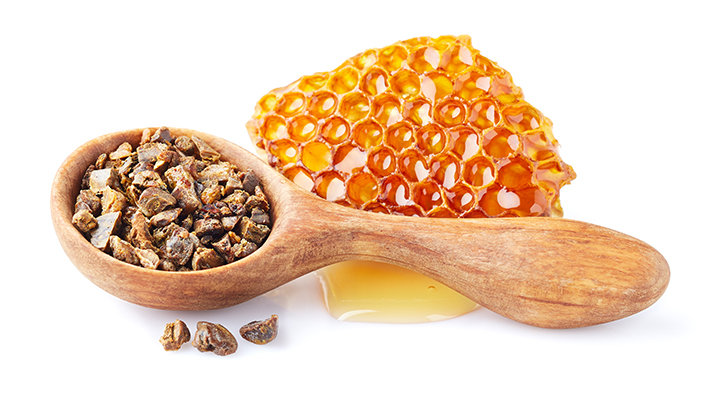
Propolis and Its Health Benefits
Bees produce more than just honey.
Other bee-derived products include royal jelly, bee pollen, propolis, beeswax and bee venom.
Propolis is a resinous substance produced by bees,
and a growing body of research suggests that it may offer several health benefits.
What Is Propolis?
Is a resin-like mixture made by bees by combining their saliva and beeswax with substances,
collected from tree buds, sap flows, and other botanical sources.
The color of propolis varies depending on the plants and trees from which the bees collect materials.
It is commonly found in shades of yellow-green, orange-green, brown, or dark brown.
Within the hive, bees use propolis to seal unwanted cracks and small openings.
Larger gaps are usually filled with beeswax.
This function is extremely important because,
unsealed openings can allow harmful intruders such as snakes, lizards, and wasps to enter the hive.
Scientists have identified more than 300 natural compounds in propolis, including:
- Amino acids
- Coumarins
- Phenolic aldehydes
- Polyphenols
- Flavonoids
- Steroids
- Resins
- Wax
Potential Health Benefits
Potential Anti-Cancer Properties
Several studies suggest that propolis contains bioactive polyphenols with potential anti-cancer activity.
Two of the most studied compounds are:
- Caffeic Acid Phenethyl Ester (CAPE), commonly found in poplar propolis
- Artepillin C, found in Brazilian Baccharis propolis
Researchers believe that propolis may help inhibit the growth of certain cancer cells in laboratory and animal studies,
by interfering with DNA synthesis and promoting apoptosis (programmed cell death).
However, more human clinical research is needed before definitive conclusions can be made.
Supports Skin Health
The antifungal, antioxidant, and anti-inflammatory properties of propolis may contribute to skin health and wound healing.
Studies suggest that propolis can help reduce oxidative stress while promoting the production of collagen and elastin,
which play important roles in skin repair and regeneration.
May Help with Candida Infections
A study published in Phytotherapy Research reported that propolis extract helped reduce symptoms of oral candidiasis in patients with Candida infections.
Additional research published in Journal of Medicinal Food suggests that propolis,
may possess significant antifungal activity against multiple yeast strains, including Candida albicans.
May Help Manage Herpes Simplex Virus (HSV)
Infections caused by the herpes simplex virus (HSV) are common worldwide.
Laboratory studies suggest that propolis may help inhibit the replication of both HSV-1 and HSV-2 viruses.
While these findings are promising, further clinical research is required to determine its effectiveness in humans.
May Support Cold and Sore Throat Relief
Research suggests that propolis extracts may help support the immune system,
and may reduce the duration and severity of common cold symptoms, including sore throat.
For this reason, propolis is commonly included in throat lozenges, sprays, and other cold-relief products.
May Help Against Certain Parasites
Giardiasis is an intestinal infection caused by the microscopic parasite Giardia lamblia.
It can be contracted through contaminated food, water, or contact with infected individuals.
Some studies have found that propolis extract may help reduce parasite levels and improve recovery rates in certain cases.
However, standard medical treatment remains the primary therapy for giardiasis.
May Support Fertility in Women with Endometriosis
Some research has investigated the effects of propolis supplementation in women experiencing infertility associated with mild endometriosis.
The findings suggest that propolis may positively influence fertility outcomes in certain women,
although larger studies are needed to confirm these results.
Forms of Propolis
Propolis is available in various forms, including:
- Creams and ointments
- Toothpastes and mouthwashes
- Throat lozenges
- Syrups
- Propolis tinctures (extracts in ethyl alcohol)
- Oral and nasal sprays
- Dietary supplements
- Soaps and shampoos
Important Note
Although propolis has shown promising results in laboratory and clinical studies,
it should not be considered a substitute for professional medical advice, diagnosis, or treatment.
Individuals who are allergic to bees or bee products should use propolis with caution and consult a healthcare professional before use.
Read also: Chlorella Health Benefits
See also: The Unique Benefits of Propolis (Bee Glue) – Dr.Berg